



Christmas traditions in Perú represent the excitement present in both a Catholic and Andean cultures; together they make each Christmas in Peru a holiday that could never occur again anywhere else. While other countries celebrate Christmas with snow covered trees, and reindeer; in Peru, Christmas represents non-European Christmas with a high level of Indian traditions, Quechua Christmas Carols, adorned retablos and various traditional gatherings that honour Jesus’s birthday along with ancient Cosmovisiones of Andes. Peruvians celebrate the Christmas tradition throughout the whole country from the tops of the mountain in Cusco to the craft market in Ayacucho where traditions keep the Indian culture alive today.
You might be interested in reading: 5 best places to visit in Peru
Understanding the cultural roots behind the christmas traditions in peru
The arrival of Spanish colonizers in the 16th century brought Catholicism to the Andes, but the Indigenous peoples never completely surrendered their ancient cosmovision. What emerged was a beautiful and resilient religious syncretism: they welcomed the new saints and holidays while weaving in their own symbols, rhythms, and meanings. Christmas, arriving right at the start of the rainy season and the agricultural rebirth, became the perfect moment for this cultural dialogue, which is exactly why the living heart of the Christmas traditions in Peru today.
The merging of Inti Raymi and navidad
Long before the Spaniards, the Incas celebrated Inti Raymi in December (southern-hemisphere summer solstice) to honor the sun god’s rebirth. When evangelization prohibited pagan festivals, indigenous communities simply moved some of their solar rituals into the Christmas traditions in Peru we know today.
- Dawn processions on December 25 echo the ancient greeting of the rising sun
- Many families still perform a small ch’alla to the four cardinal points before Christmas dinner
- The idea of a “child god” who brings light was easily identified with the young sun of the solstice
The andean influence on christmas traditions in Peru
Geography is destiny, and the Andes impose their rhythm on everything, including Christmas. Living at 3,000–5,000 meters above sea level has shaped not only the food and clothing people use, but also the very concept of community and celebration.
Altitude and communal survival
At 3,000 to 5,000 meters above sea level, survival has always depended on unbreakable community bonds between families and neighbors. This reality deeply shapes the Christmas traditions in Peru, turning the holiday into the year’s greatest celebration of interdependence and solidarity. On Christmas Eve, entire communities share firewood to build the towering fireworks castles, women work side-by-side for days preparing hundreds of tamales, and whole villages, bundled in their finest ponchos, walk together by candlelight or flashlight to midnight mass beneath a sky full of stars and freezing air.
- The concept of “mink’a” (communal work) is visible in every big tradition: building retablos, organizing chocolatadas, or raising the castillo de fuegos
- Sharing is so important that refusing to participate can bring social sanctions
- This solidarity explains why even the poorest communities manage spectacular celebrations
Traditional foods, music, and rituals during peruvian christmas
Food, dance, and faith intertwine seamlessly in the Andes. Christmas Eve dinner is rarely just a meal; it is a ritual of gratitude to the earth for its harvest and one of the most delicious Christmas traditions in Peru. Music fills the air from the moment the sun sets, and fireworks light up the sky at midnight as a symbolic offering to the apus.
The soundscape of Andean Navidad
You cannot separate the Christmas traditions in Peru from their music. From the tiny charango to the deep drone of the wakrapuku (cow-horn trumpet), every instrument has a role. The sound is raw, high-pitched, and often slightly out of tune to Western ears, but it carries the emotion of centuries.
- Wind instruments dominate because they “speak” to the mountains and the wind
- Huayno and carnaval rhythms replace waltzes and polkas in most highland homes
You might be interested in reading: Peru Travel Guide: Essential Tips for Your Journey
The most iconic christmas traditions in Peru
Here are ten deeply rooted traditions that highlight Andean identity during the holiday season and together form the living soul of the christmas traditions in Peru:
1. The niño manuelito devotion
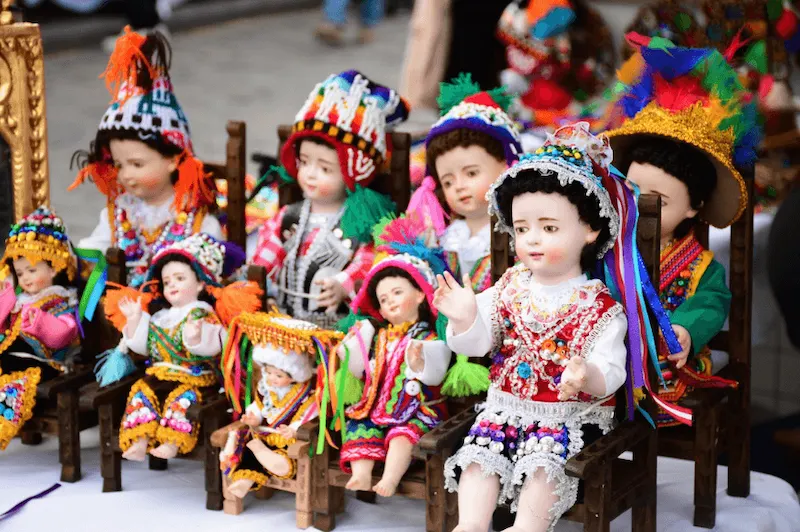
In many Andean households, especially in the rural communities of Cusco, Apurímac, and Ayacucho, the baby Jesus is lovingly called Niño Manuelito or Taytacha Manuelito. Far from the European infant dressed in white, this sacred image wears bright handmade Andean clothing complete with a tiny chullo (wool hat) and a finely woven mantle. Families “adopt” the Niño for an entire year, treating him as a real child of the house: they dress him according to the season, sing him lullabies, and even carry him on walks through the fields to bless the crops and ensure a good harvest. This tender, year-long care is one of the most heartfelt and distinctive Christmas traditions in Peru.
- The family chosen as caretaker receives great honor in the community
- On February 2 (Candlemas), the image is returned to the church in a procession with huayno music and flower offerings
- Some families keep the same Niño Manuelito for generations, passing the responsibility down like an heirloom
2. Andean-style nativity scenes (Retablos Ayacuchanos)
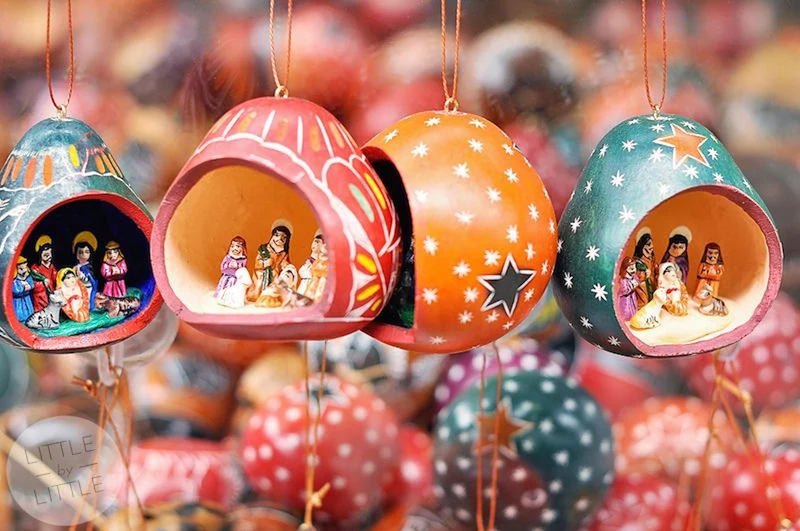
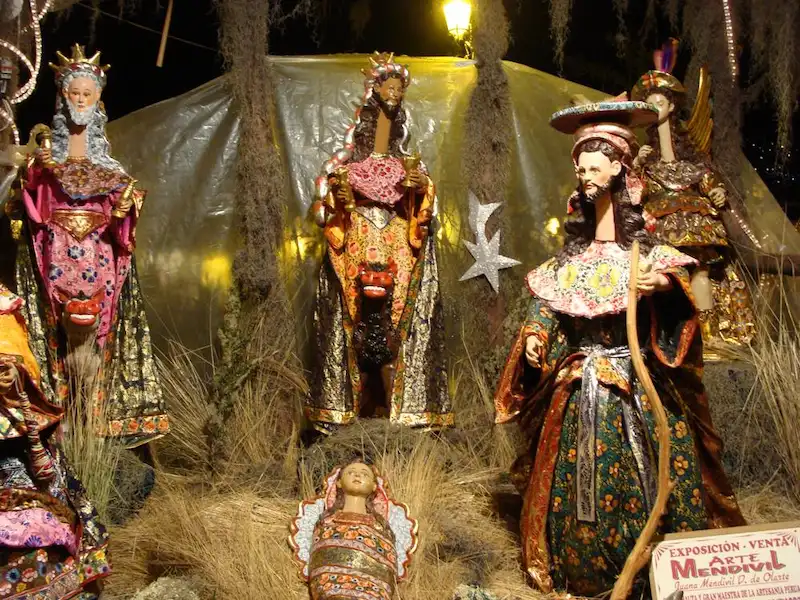
The famous retablos from Ayacucho are portable wooden boxes that tell stories through painted clay figurines. As part of the christmas traditions in Peru, these retablos transform during December into elaborate nativity scenes where Mary and Joseph wear traditional Andean dress, the three wise men ride llamas instead of camels, and the setting is a mountain landscape complete with quinoa fields and snow-capped peaks.
- Master artisans spend months carving hundreds of tiny pieces
- Baby Jesus is often placed inside a small woven cradle called a “q’epirina”
- Many retablos include local animals such as vizcachas, condors, and alpacas alongside the classic sheep
3. Chocolatadas as community gatherings
One of the most heartwarming Christmas traditions in Peru is the chocolatada, where families and even tourists distribute thick hot chocolate and panetón to children in highland communities, turning charity into celebration.
- In remote villages, neighbors pool resources for weeks to buy ingredients
- The hot chocolate is made with real cacao, cloves, cinnamon, and sometimes quinoa or kiwicha for extra nutrition
- After exploring ancient trails like the breathtaking Perolniyoc Waterfall Hike full day, many travelers choose to join a local chocolatada as a way to give back to the communities that preserve these traditions
4. Danza de tijeras performances
The scissor dance, declared Intangible Cultural Heritage by UNESCO, reaches its emotional peak during Christmas and the Bajada de Reyes festivities. Dancers in colorful costumes perform acrobatic leaps while playing harp and violin, “testing” their physical and spiritual strength in front of the Niño Jesús.
- Each step is believed to be a dialogue with the mountain spirits
- The metallic sound of the scissors represents lightning and power
- Competitions can last hours, with dancers never touching the ground with their hands
5. Midnight mass known as “Misa de Gallo”
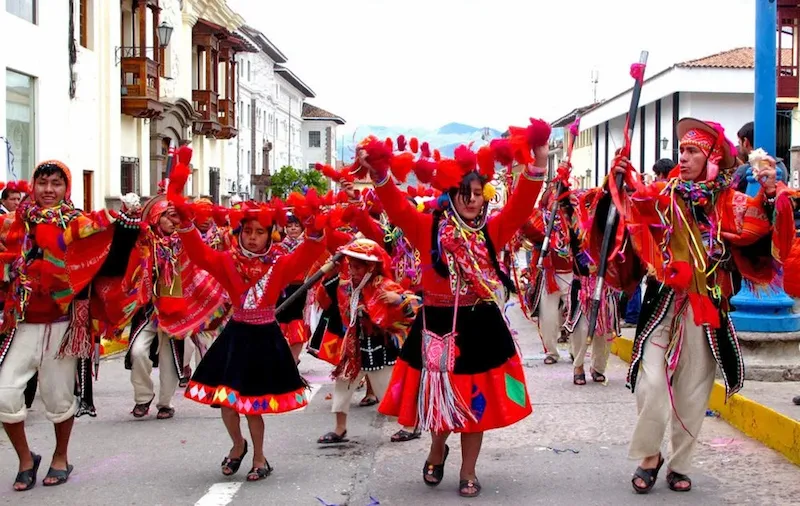
Known as the Rooster’s Mass, this beautiful service begins exactly at midnight on Christmas Eve and forms the spiritual center of the Christmas traditions in Peru. In Andean villages, entire families bundle up in their finest ponchos and polleras and walk together by candlelight or flashlight toward the church, which often sits high on a hillside overlooking the valley.
- Many attendees wear their finest handwoven ponchos and polleras
- After mass, families return home to share the traditional Christmas Eve supper
- In some villages, the priest blesses bundles of crops brought by farmers
You might be interested in reading: Huayna Picchu or Machu Picchu
6. Exchange of handmade grafts
In the highlands of Cusco and Puno, christmas traditions in Peru reflect the strong spirit of reciprocity rooted in Andean culture. Christmas is the perfect moment to exchange small handmade offerings that symbolize gratitude and mutual support. These are not commercial gifts wrapped in shiny paper; they are miniature replicas of things people desire for the coming year: tiny houses, cars, farm animals, or even university diplomas, all carefully crafted from wood, clay, or wool.
- The act of giving an alajito is a way of “asking” the universe or the apus for that wish to come true
- On Christmas Eve, families place these miniatures around the nativity scene as offerings to the baby Jesus
- Artisans from towns like Pisac and Chinchero sell thousands of them in December, and many visitors who have experienced the impressive Q’eswachaka bridge tour full day return home with a set of alajitos as meaningful souvenirs
7. Andean christmas carols (villancicos quechuas)
While “Noche de Paz” is sung everywhere, the true soul of the Christmas traditions in Peru emerges in the villancicos quechuas, those hauntingly beautiful songs that turn every Andean night into magic. Their lyrics speak of the birth of the “Wawa Dios” in a cold Andean night, surrounded by llamas, vicuñas, and under the shining Southern Cross.
- Groups of children and adults go house to house singing from December 16 onward, receiving small tips or treats
- Some of the most beloved are “Niñucha Dios”, “Wawaq Wasi” and “Taytacha Raymi”
- In Cusco’s Plaza de Armas, massive communal singing events called “cantatas navideñas” gather thousands under the illuminated cathedral
8. Family dinners with andean ingredients
The Christmas Eve table is one of the most delicious and sacred expressions of the Christmas traditions in Peru. While coastal families enjoy turkey and tamales, highland homes serve dishes that have been prepared for centuries with local ingredients: roast pork or lamb seasoned with huacatay (Andean black mint), purple potatoes stuffed with cheese, quinoa soups, and roasted cuy for special occasions.
- The main dish is often accompanied by “canchán” (roasted corn with cheese) and “tamales de maíz morado”
- Hot drinks include ponche made with macerated fruits, cinnamon, and a touch of pisco or cañazo
- Every ingredient is thanked with a small offering of ch’alla (sprinkling alcohol or coca leaves on the ground for Pachamama)
9. Fireworks and street festivities on christmas eve
At the stroke of midnight, the Andean sky explodes in color and sound, marking one of the loudest and most joyous Christmas traditions in Peru. Fireworks are far more than entertainment; they scare away negative spirits, greet the newborn sun of the new cycle, and announce to the apus that the Child has arrived. In towns like Huancavelica, Ayacucho, or Paucartambo, entire neighborhoods compete to build the tallest and loudest displays.
- Families light “voladores” and “castillos” (multi-level firework towers) that can reach several stories high
- Streets fill with brass bands playing huaynos while people dance until dawn
- The tradition is so intense that some towns declare December 24 as a “non-working day” just to recover from the celebration
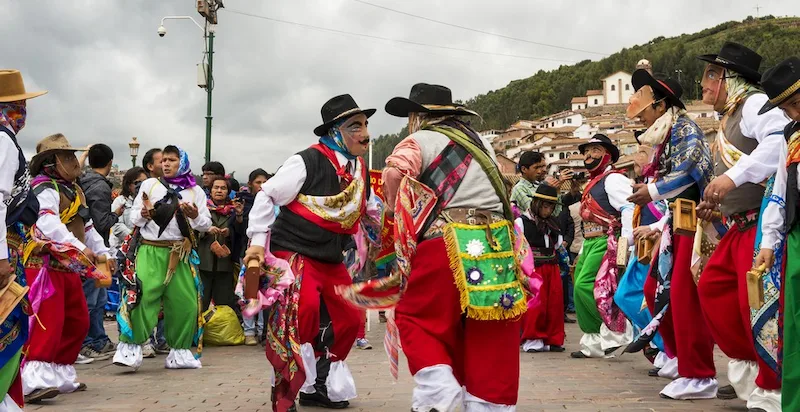
10. Santurantikuy fair in cusco
Held every December 24 in the Plaza de Armas of Cusco, Santurantikuy (“the sale of saints” in Quechua) is the largest and most dazzling artisan market of the Christmas traditions in peru. From the first light of dawn until the sky ignites with fireworks, hundreds of vendors spread their colorful textiles on the ancient cobblestones, offering everything needed for the perfect Andean nativity scene: mountain moss, tiny ceramic animals, miniature farming tools, and of course, dozens of versions of the beloved Niño Manuelito dressed in miniature polleras and chullos.
- The fair dates back to colonial times but maintains strong indigenous organization
- Bargaining is part of the ritual, accompanied by cups of hot api (sweet corn drink)
- Many families complete their purchases just hours before the Misa de Gallo, carrying their treasures home under a sky already lit by the first fireworks
You might be interested in reading: Glamping in the Desert: A Magical Escape Beneath the Peruvian Stars
How andean heritage shapes modern christmas traditions in Peru
Christmas traditions in Perú are preserved through its Andean roots. The Andean Christmas traditions that permeate Peru continue to exist, because each year thousands of youth who leave their hometowns in search of employment in cities will return to their hometown to celebrate Christmas. As a result of social media, traditional Andean Christmas customs are being brought to life. Videos posted on social networks showing artisans selling retablos to customers all around the globe while explaining the significance of each tiny llama depict the survival of the Andean spirit of Christmas.
Furthermore, the growing number of experiential tourism opportunities is evidence of the survival of the Andean Christmas spirit in Peru. Tourists can now experience the Andean Christmas spirit through experiential activities such as dining with families in the Sacred Valley; assisting in constructing castillos de fuegos artificiales for the holiday season; and learning to play the zampoña during the weeks leading up to Navidad.
