



Hi, dear reader! Today, we are going to talk about one of my favorite topics of all time: The Tahuantinsuyo. This was the largest civilization in the Precolumbian America. This was the largest civilization in pre-Columbian America and encompassed several Latin American countries. Their discovery made evident the organization they had and the connection with their beliefs. Currently, it still has many mysteries to be discovered. So, let’s know more about this amazing empire.
You might also be interested in: How to Train for the Inca Trail: The Best Guide for Hikers 2025
What was the Tahuantinsuyo?
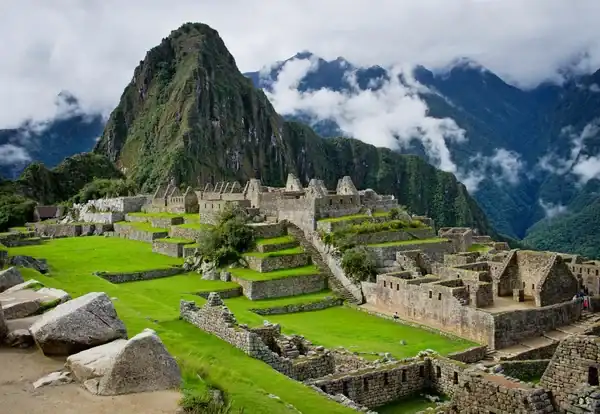
Tahuantinsuyo was the mighty Inca empire, a civilization that dominated the Andes through advanced engineering, agriculture, and a deep spiritual connection with nature. Spanning six modern countries, it was the most powerful pre-Columbian empire in South America, with Cusco as its political and religious center.
The meaning of “Tahuantinsuyo” and its significance
The word Tahuantinsuyo comes from Quechua: Tawantin means “four parts united,” and Suyu means “region” or “province.” This name reflected the Inca empire’s division into four great regions, all connected to Cusco, the sacred capital. More than just a political term, Tahuantinsuyo symbolized the Incas’ vision of unity and harmony under a single ruler, the Sapa Inca.
How the Inca empire became the largest civilization in pre-Columbian America
At its peak, Tahuantinsuyo stretched across modern-day Peru, Ecuador, Bolivia, Chile, Argentina, and Colombia, making it the most extensive empire in the Americas before the arrival of the Spanish. This vast expansion was achieved through strategic military conquests and a highly organized administration that integrated diverse cultures into the Inca way of life.
The role of Cusco as the center of the empire
Cusco was more than just a capital—it was the navel of the world, the sacred heart of Tahuantinsuyo. From here, the Incas controlled their vast empire through an intricate network of roads (Qhapaq Ñan) and administrative centers. The city was home to grand temples, including Coricancha, the Temple of the Sun, which was covered in gold to honor Inti, the sun god.
You might also be interested in: Top 5 best inca trail tour companies
The four suyus: the regions of Tahuantinsuyo
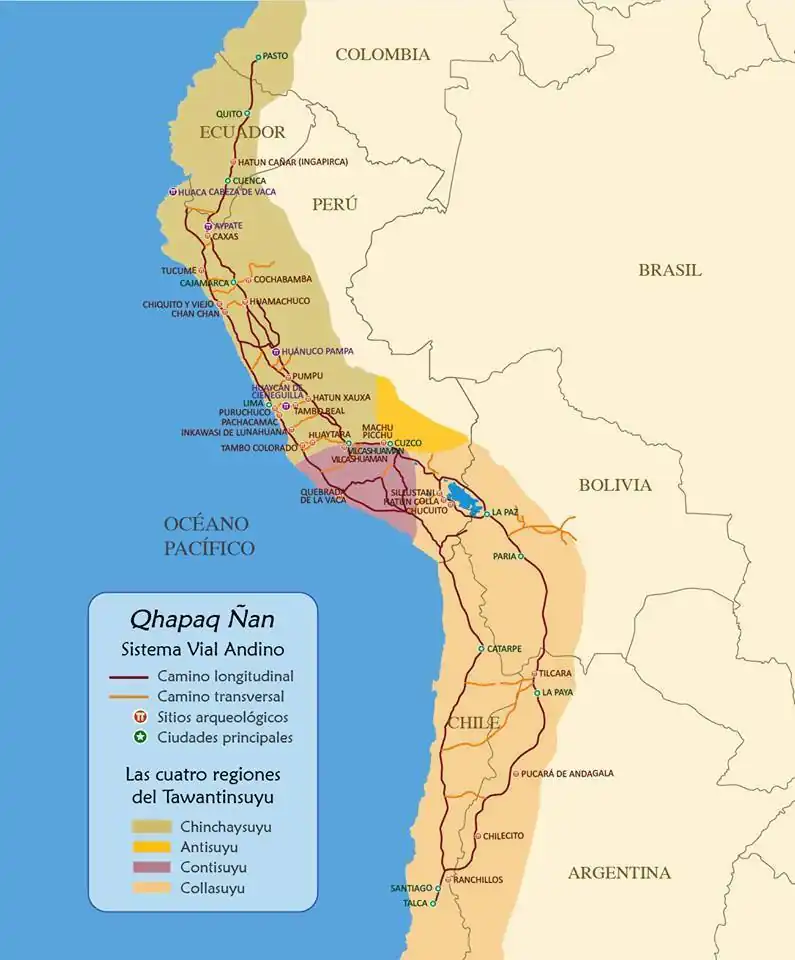
To keep control over its vast empire, the Inca civilization divided Tahuantinsuyo into four great regions, or suyus: Chinchaysuyo, Antisuyo, Contisuyo, and Collasuyo. Each had its own distinct geography, climate, and resources, ensuring the empire’s self-sufficiency.
From the fertile coasts to the high Andes and deep jungles, these regions were connected by the impressive Qhapaq Ñan road system, allowing the Incas to move armies, goods, and messages with incredible efficiency. This division wasn’t just practical—it also reflected their belief in balance and harmony between nature and society.
Chinchaysuyo: the heart of power
Chinchaysuyo was the largest and most powerful region of Tahuantinsuyo, stretching north from Cusco into present-day Peru, Ecuador, Colombia, Bolivia, and Chile. This vast territory made it the empire’s economic and political center, controlling the most productive farmlands and strategic trade routes.
Why was it so important?
- Agricultural hub: Chinchaysuyo had fertile valleys and coastal lands, producing maize, potatoes, cotton, and coca leaves, which were essential for the empire’s economy.
- Trade and commerce: Lively markets connected highland farmers with coastal fishermen, allowing the exchange of textiles, seafood, and precious metals.
- Cultural influence: The Incas assimilated advanced knowledge from conquered civilizations like the Chimú, enhancing their metalwork, irrigation, and architecture.
- Political power: The region had the largest population, making it the strongest base of Inca control outside of Cusco.
Famous sites of Chinchaysuyo
- Machu Picchu: One of the most breathtaking remnants of the empire, this royal estate remains an architectural marvel. If you’re planning to visit, exploring Machu Picchu tours is the best way to experience its history.
- Chan Chan: Once the capital of the Chimú civilization, later conquered by the Incas.
- Quito: A major administrative center after the Incas expanded northward.
With its wealth, innovation, and cultural diversity, Chinchaysuyo was the beating heart of the Inca empire—a region where trade, agriculture, and politics shaped the destiny of Tahuantinsuyo.
Antisuyo: the gateway to the Amazon
Antisuyo was the smallest but most enigmatic region of Tahuantinsuyo, stretching east of Cusco into the dense Amazon rainforest. Unlike the other suyus, this region was covered in thick vegetation, making it a land of mystery, rich biodiversity, and fierce resistance.
A bridge between the Andes and the Amazon
- Mystical and untamed: The Incas considered the jungle a sacred and dangerous place, home to powerful spirits and unknown creatures.
- Connection with Amazonian tribes: The Incas traded with groups like the Machiguenga and Asháninka, exchanging coca leaves, exotic feathers, medicinal plants, and gold.
- Challenges of expansion: Unlike other regions, Antisuyo was difficult to control due to its rugged terrain, tropical climate, and the fierce independence of its inhabitants.
Key sites in Antisuyo
- Vilcabamba: The last stronghold of the Incas, where the resistance against the Spanish continued for decades.
- Manu and Madre de Dios: Important regions for Inca exploration and resource extraction.
Despite its challenges, Antisuyo played a vital role in trade, spirituality, and Inca expansion. It remains one of the least understood regions of the empire, preserving many secrets of the Inca connection with the Amazon.
Contisuyo: where the mountains meet the ocean
Contisuyo was the westernmost region of Tahuantinsuyo, extending from the Andes to the Pacific coast. This area, which includes present-day Arequipa, Moquegua, and Tacna, was home to ancient civilizations like the Nasca, Paracas, and Tiwanaku, whose knowledge the Incas absorbed and expanded upon.
A region of contrast and adaptation
- Coastal influence: Unlike the highlands, Contisuyo had an arid climate with vast deserts and fertile river valleys where civilizations thrived.
- Maritime resources: The Incas relied on the coast for fish, seaweed, and salt, incorporating these into their vast trading networks.
- Agricultural ingenuity: They adapted to the dry lands using advanced irrigation systems and terraced farming to cultivate maize, cotton, and ají peppers.
Key sites in Contisuyo
- Arequipa: A strategic Inca settlement surrounded by volcanoes. Today, exploring its history is one of the highlights of Arequipa tours.
- Toro Muerto: A vast collection of petroglyphs, evidence of early Andean cultures.
- Moquegua Valley: A major agricultural center that supplied food to Cusco and beyond.
Although often overshadowed by the highland regions, Contisuyo played a crucial role in the empire’s economy. It served as a bridge between the Andean heartland and the rich maritime resources of the Pacific.
Collasuyo: the vast highlands
Collasuyo was the largest and coldest region of Tahuantinsuyo, covering the southern Andes, including present-day Bolivia, northern Chile, northern Argentina, and southern Peru. Its harsh climate and high altitudes made it a challenging yet vital part of the empire.
A land of lakes, llamas, and powerful cultures
- Lake Titicaca: Considered the cradle of Inca mythology, it was a sacred site and a major center of trade and religious activity.
- The Aymara influence: Before the Incas, the Aymara and Tiwanaku cultures dominated this region, contributing their language, agricultural techniques, and religious traditions.
- Camelid economy: Llamas and alpacas were essential for transport, wool, and meat, sustaining both the local populations and the empire’s economy.
Key sites in Collasuyo
- Lake Titicaca: The legendary birthplace of Manco Cápac, the first Inca ruler.
- Sillustani: A pre-Inca burial site with impressive stone towers (chullpas).
- Potosí: A city rich in silver, later exploited by the Spanish.
Despite its extreme conditions, Collasuyo was crucial for agriculture, trade, and spiritual life. It connected the empire to rich mineral resources and ancient Andean traditions, reinforcing the Inca legacy across South America.
You might also be interested in: Peruvian Foods | A Culinary Journey
The Tahuantinsuyo flag: history and symbolism
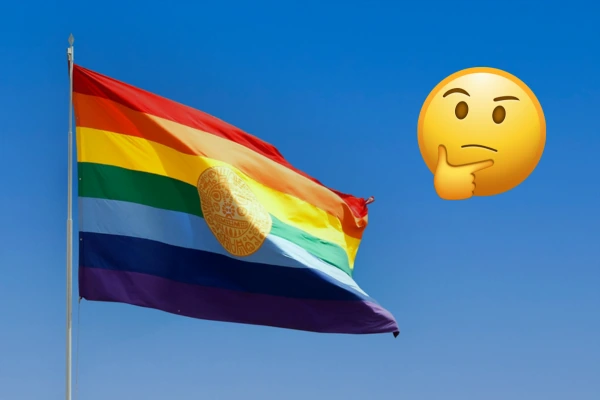
Many people associate the rainbow flag with the Inca Empire, but was it really their emblem? Let’s explore the truth behind this widespread misconception and uncover the real banners and symbols used by the Incas.
The misconception of the rainbow flag as the Inca emblem
The rainbow flag is widely believed to be the official banner of Tahuantinsuyo, but historical records tell a different story. There is no evidence that the Incas used a multicolored flag to represent their empire. This idea became popular in the 20th century, when the city of Cusco adopted it as a symbol of Andean identity. However, Spanish chroniclers, including Garcilaso de la Vega and Bernabé Cobo, never mentioned a rainbow flag in their descriptions of Inca banners and standards.
The modern rainbow flag, which features seven colors, is often mistaken as an ancient Inca emblem. In reality, it was first promoted in 1973 by Cusco’s mayor, and later became the city’s official flag. While it represents indigenous pride today, it is not an accurate historical symbol of the Incas.
The real standards and banners used by the Incas
Rather than a single flag, the Incas used a variety of banners, emblems, and standards to represent their empire. These symbols carried deep meaning and were often associated with social status, military power, and religious beliefs. Some of the most notable banners included:
- The “Unancha” – A rectangular or square banner featuring geometric designs and bright colors. It was commonly used in ceremonies and military parades, carried by Inca generals and nobility.
- The Inca’s personal standard – A red banner with golden fringe, symbolizing the authority and divine status of the Sapa Inca. This was likely the closest thing to an imperial flag.
- Golden emblems and totems – The Incas often carried golden or silver plaques with symbols of the sun (Inti), thunder (Illapa), or the moon (Mama Killa), emphasizing their spiritual beliefs.
These banners and emblems served both political and ceremonial purposes, reinforcing the power of the Inca state. Unlike modern flags, they were not mass-produced or displayed in every province but rather used selectively by rulers, priests, and military leaders.
The importance of colors and symbols in Inca identity
Even if the Incas didn’t use a rainbow flag, colors played a crucial role in their society. Different hues were associated with social hierarchy, religious beliefs, and territorial divisions. Some of the most important colors included:
- Gold and yellow: Represented the sun god, Inti, and the divine power of the Sapa Inca. Many sacred objects, including the famous golden sun disk of Coricancha, were decorated in gold.
- Red: Symbolized war and strength, often used in military banners and noble garments. The Inca army’s shields and tunics frequently featured red patterns.
- Black and white: Represented duality, a key concept in Andean spirituality. These colors symbolized life and death, the upper and lower worlds, and were commonly seen in sacred textiles.
- Green and blue: Associated with fertility, water, and nature. Many ceremonial tunics, known as unku, included green and blue details to honor the Pachamama (Mother Earth).
While the rainbow flag has become a modern representation of Tahuantinsuyo, the true symbols of the Inca Empire were deeply rooted in their religious and political traditions. Their banners, emblems, and textiles reflected a sophisticated worldview, where every color and design carried meaning beyond simple decoration.
You might also be interested in: Best time to visit Peru: Arrive at the perfect moment
How did the Incas govern the Tahuantinsuyo?
The Inca Empire, or Tahuantinsuyo, was one of the most efficiently governed civilizations in history. Despite its vast territory, stretching across present-day Peru, Ecuador, Bolivia, Chile, Argentina, and Colombia, the Incas maintained strict control through a highly organized political and administrative system. Let’s explore how they managed their empire and ensured stability.
The role of the Sapa Inca as a divine ruler
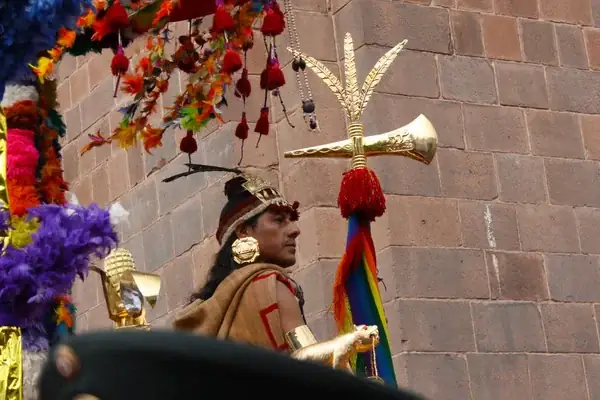
At the top of the political structure was the Sapa Inca, the absolute ruler of Tahuantinsuyo. Considered a living god and descendant of Inti, the sun god, he had total authority over laws, resources, and military campaigns.
The Sapa Inca lived in Cusco, the empire’s capital, surrounded by an elite class of advisors, priests, and generals. His divine status meant that his word was law, and his people owed him loyalty and labor. He also led grand ceremonies in places like Machu Picchu and Inti Punku—the famous Inti Punku hike today takes visitors through one of the empire’s sacred gateways, where the sun god was honored.
The strict yet efficient administrative system
To manage such a vast empire, the Incas divided Tahuantinsuyo into four regions, or suyus, each governed by a local leader called an Apu. These regions were:
- Chinchaysuyo (northwest)
- Antisuyo (northeast)
- Collasuyo (southeast)
- Contisuyo (southwest)
Each suyu was further divided into smaller provinces, ruled by curacas (local chiefs) who ensured that the population followed Inca laws, paid tribute, and contributed to public works. The government kept records using quipus, a system of knotted cords that allowed them to track taxes, population data, and labor contributions.
The Inca road system, known as the Qhapaq Ñan, played a crucial role in governance. This massive network of roads and bridges allowed messengers, known as chasquis, to carry orders from Cusco to the most remote parts of the empire in just a few days.
The mit’a system: labor as a form of tribute
Instead of paying taxes with money, the Incas used the mit’a system, a form of mandatory labor tribute. Every citizen was required to work for the state for a certain period each year, contributing to the empire’s economy and infrastructure.
The mit’a system ensured the construction of:
- Temples and religious centers, such as Coricancha in Cusco.
- Roads and bridges, facilitating communication and trade.
- Terraces and irrigation systems, improving agricultural productivity.
In return, the Inca government provided food, clothing, and security to its people, ensuring that no one went hungry. This system, while strict, allowed the empire to flourish and maintain social order.
The success of Inca governance lay in its balance between control and reciprocity. Through a mix of divine authority, administrative efficiency, and collective labor, the Incas built one of the most remarkable civilizations in history—an empire that still fascinates us today.
You might also be interested in: How to get to Waqrapukara?
Daily life in the Tahuantinsuyo
Life in the Tahuantinsuyo was a perfect balance between hard work, community values, and deep spiritual traditions. The Incas developed advanced agricultural techniques, built awe-inspiring architectural wonders, and lived in harmony with nature and the cosmos. Let’s dive into the daily lives of the people who made up this great empire.
The advanced agricultural techniques that sustained the empire
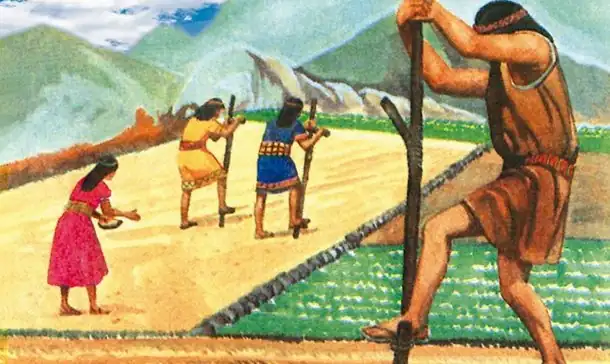
Feeding a vast empire that spanned diverse climates and landscapes required ingenious agricultural innovations. The Incas perfected techniques that maximized crop yields and ensured food security, even in the harshest environments.
- Andean terraces (andenes): The Incas carved stair-like fields into the mountains to prevent soil erosion and create fertile farmland.
- Irrigation channels: They built sophisticated irrigation systems to direct water from glaciers and rivers to dry areas.
- Crop diversity: They cultivated over 3,000 varieties of potatoes, as well as quinoa, maize, and coca leaves.
- Storage centers (qollqas): The Incas developed massive food storage facilities to prevent famine during droughts or harsh winters.
These innovations allowed the Tahuantinsuyo to sustain a growing population and support large-scale construction projects without food shortages.
The architectural marvels: from Machu Picchu to Sacsayhuamán
Inca architecture was not only functional but also a testament to their engineering genius. Their ability to construct earthquake-resistant structures without using mortar remains a mystery today.
Some of the most iconic structures include:
- Machu Picchu: A royal estate and religious sanctuary that harmonizes perfectly with its mountain surroundings.
- Sacsayhuamán: A massive fortress in Cusco, built with colossal stone blocks, some weighing over 100 tons.
- Ollantaytambo: A strategic military and religious site, showcasing intricate stonework and agricultural terraces.
These marvels still stand today, defying time and nature, proving that Inca engineering was centuries ahead of its time.
The deep spiritual connection with nature and celestial bodies
Spirituality was woven into every aspect of Inca daily life. They believed in living in harmony with nature, as every mountain, river, and celestial body had a sacred meaning.
- Inti (the Sun God): The most important deity, worshipped in grand ceremonies like Inti Raymi.
- Pachamama (Mother Earth): Incas honored her through rituals and offerings to ensure fertility and prosperity.
- Astronomy: They built observatories, like the Temple of the Sun in Machu Picchu, to track the movements of the sun and stars.
Everyday actions, from farming to building, were carried out with a sense of reverence for the natural and spiritual world.
The Tahuantinsuyo was more than just a powerful empire—it was a harmonious society where agriculture, architecture, and spirituality worked together to create an advanced and sustainable civilization.
You might also be interested in: 10 things to do before going overseas
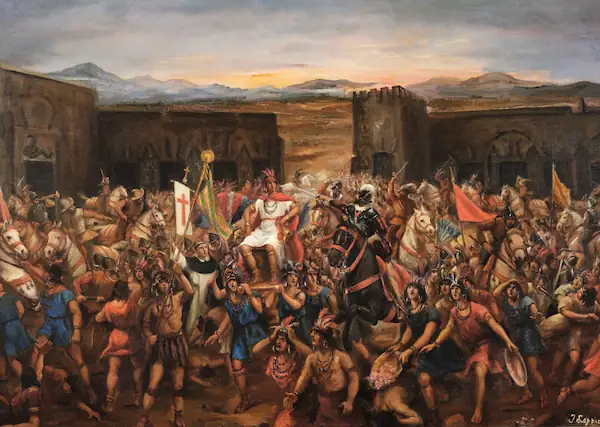
Painting by Juan Lepiani depicting the capture of Atahualpa in Cajamarca.
The fall of Tahuantinsuyo: from power to destruction
The mighty Tahuantinsuyo seemed unstoppable, but internal conflicts and foreign invasions led to its dramatic downfall. A civil war between royal brothers, the arrival of the Spanish, and a final stand in Vilcabamba sealed the fate of the greatest empire in South America.
The civil war between Huáscar and Atahualpa that weakened the empire
Before the Spanish set foot in the empire, the Incas were already engaged in a brutal power struggle. Emperor Huayna Cápac had died unexpectedly, leaving the throne disputed between his sons:
- Huáscar: Based in Cusco, he was the legitimate heir but struggled to maintain loyalty.
- Atahualpa: Ruling from Quito, he had the support of seasoned warriors from the north.
The war between the brothers lasted for years, devastating cities, weakening armies, and dividing the empire. When Atahualpa finally triumphed in 1532, his forces were exhausted—just as the Spanish arrived.
The arrival of the Spanish and the betrayal of the Incas
The Spanish, led by Francisco Pizarro, arrived in Peru in 1532, finding a fractured empire. They took advantage of the internal strife, using deception and alliances to gain control.
- The capture of Atahualpa: Pizarro invited Atahualpa to a meeting in Cajamarca and ambushed him, taking him hostage.
- The ransom that wasn’t enough: The Inca emperor offered a room filled with gold and silver for his freedom, but the Spanish executed him anyway.
- Divide and conquer: The Spanish exploited rivalries among the Incas, turning local factions against each other.
Within a few years, Cusco fell, and the Tahuantinsuyo was in Spanish hands.
The final resistance in Vilcabamba and the end of an era
Even after Cusco’s fall, the Incas did not surrender completely. The last Inca rulers retreated to Vilcabamba, deep in the jungle, where they continued to resist Spanish rule.
- Manco Inca led a rebellion (1536-1537), nearly retaking Cusco but was ultimately defeated.
- Túpac Amaru, the last Inca ruler, was captured in 1572 and executed in Cusco, marking the definitive end of the Inca resistance.
With the death of Túpac Amaru, the Tahuantinsuyo officially came to an end, but its legacy continues to shape Andean culture to this day.
Tahuantinsuyo’s enduring legacy in modern South America
Although the Tahuantinsuyo fell centuries ago, its influence is still deeply rooted in modern-day Peru, Bolivia, Ecuador, and beyond. From language and traditions to architecture and roadways, the Inca legacy continues to shape South America in remarkable ways.
The survival of Inca traditions in modern-day Peru, Bolivia, and Ecuador
Many customs and rituals from the Inca era remain alive today, passed down through generations. In towns and cities across the Andes, you can still witness:
- Inti Raymi celebrations: The Festival of the Sun, once the most important Inca ritual, is still celebrated every June in Cusco.
- Traditional weaving techniques: Indigenous communities use ancient methods to create textiles with symbolic patterns.
- Andean agriculture: The Incas developed terrace farming, and their techniques are still used today to grow quinoa, potatoes, and maize.
Despite centuries of colonization, the spirit of the Incas endures in the everyday lives of Andean people.
The preservation of Quechua, the language of the Incas
The Inca Empire’s official language, Quechua, is still spoken by millions across South America. In Peru, Bolivia, and Ecuador, it holds official status, and efforts are being made to revitalize and promote its use:
- Quechua-language radio stations and TV programs help keep the language alive.
- Bilingual education programs ensure younger generations learn Quechua alongside Spanish.
- Cultural pride movements encourage people to reclaim and celebrate their indigenous roots.
Rather than fading into history, Quechua remains a vital part of South American identity.
How the Inca road system still influences modern infrastructure
The Qhapaq Ñan, or Inca Road System, was an engineering marvel, stretching over 40,000 km across mountains, jungles, and deserts. Today, parts of this ancient network still serve as key transportation routes.
- Many modern highways and rural paths follow the same routes as Inca roads.
- Trekkers from around the world hike along sections like the Inca Trail to Machu Picchu.
- UNESCO has designated the Qhapaq Ñan as a World Heritage Site, highlighting its cultural and historical significance.
Even in the 21st century, the Inca infrastructure remains relevant, proving the genius of Andean engineering.
Conclusion
I feel that the whole blog has fallen short compared to the grandeur of Tahuantinsuyo. Even visiting it takes time because it covers so much territory that we should make many trips or take enough time to know it in its entirety. Anyway, this civilization is a vestige of a culture that has managed to prevail in people, not only Andeans but worldwide, keeping its legacy alive. Let us continue to highlight this precious culture and not let it be forgotten.
